GAME DESIGN
Balancing powerful abilities through risk and reward
Cyber Gomoku introduces three abilities that do not exist in standard Gomoku. Early versions made each one either too dominant or too weak, undermining the careful reading that makes Gomoku interesting.
Balance work centered on one principle: a powerful effect should carry a comparable risk or opportunity cost. Instead of reducing every effect, the design creates meaningful decisions about when and where to use it.
Two lessons from established game design
Two patterns found across long-running games provided a useful starting point.
- Make comeback tools more valuable to the player who is behind: Party games often limit the value of a comeback item for the leader while increasing its impact for the trailing player. Cyber Gomoku's bomb follows that pattern: it is more valuable for breaking an opponent's formation than for protecting an already dominant board.
- Attach a cost to powerful effects: Card games make strong cards expensive to play. Cyber Gomoku uses different costs instead of currency: spending a move, accepting a two-use limit, or revealing information to the opponent.
Studying the purpose of a mechanic—not copying its surface appearance—provides a practical foundation for balancing a small original game.
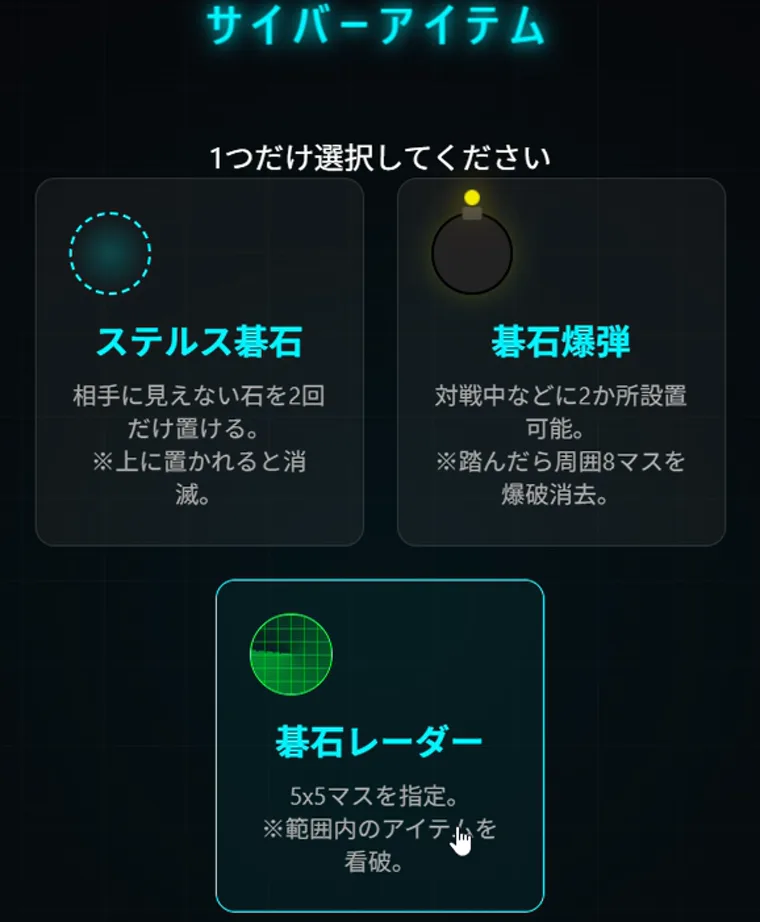
Stealth Stone: powerful on offense, useless for blocking
A Stealth Stone is hidden from the opponent and can complete an unnoticed line of five. Its main limitation is defensive: a hidden stone does not block the opponent's line.
If the opponent places a normal stone on the same intersection, the Stealth Stone is discovered and disappears. Its owner loses both the move spent placing it and one of the limited uses, so it rewards prediction rather than providing a safe advantage.
Stone Bomb: changing the board at your own risk
A Stone Bomb is a trap that destroys every nearby stone when the opponent steps on its intersection. It can break a nearly completed enemy line, but any friendly stones in the same area also disappear.
Planting the bomb also consumes a turn. Investing a move in a trap that may never trigger is dangerous while the opponent is attacking. The powerful effect is offset by delayed value and the possibility of destroying your own position.

Stone Radar: spending an ability slot on a prediction
Stone Radar detects Stealth Stones and bombs within its scan area. Activating it does not consume a turn, but choosing it uses the single ability slot selected before a match.
If the opponent does not choose a hidden item, radar provides little value. Its cost is the possibility that your prediction about the opponent's strategy is wrong.
Current abilities, rewards, and risks
After repeated adjustments, each ability now fills a distinct role. See the rules and abilities guide for exact behavior.
- Stealth Stone: Up to two uses. Reward: an invisible attack. Risk: if the opponent chooses the same intersection, the hidden stone disappears and both the move and use are lost.
- Stone Bomb: Up to two uses. When triggered, it destroys stones on both sides in a 3 × 3 area. Reward: breaking an advanced formation. Risks: spending a move to plant it and losing friendly stones in the blast.
- Stone Radar: Up to two uses. It scans a 5 × 5 area for five turns. Reward: revealing hidden information. Risk: the selected ability has little value if the opponent uses no hidden item.
The three roles are offense (stealth), board reset (bomb), and detection (radar), and each pays a different kind of cost. Balance does not require identical power; it requires distinct roles with meaningful trade-offs.
Measure decisions, not only numbers
Early builds included a bomb with too little range and radar that could scan the entire board. Each change to range or uses was evaluated by asking whether the other player still had a response and whether both sides still needed to predict each other.
Whole-board radar was a clear failure because it completely answered stealth and removed the reason to choose it. Reducing radar to a 5 × 5 area created a decision about where to scan while leaving the stealth player a counterplay: choose an area the radar may miss. Making the ability weaker made the interaction more interesting.
The current balance is not considered final. Match results and player feedback will continue to guide adjustments that preserve a distinct purpose for each ability.
This article summarizes the rules and adjustment process actually implemented in Cyber Gomoku based on the developer's own experience.